Showing posts with label rice. Show all posts

Sunday, March 17, 2013

Hoppin' John and Collard Greens

I've been wanting to try Hoppin' John for quite some time.  What could be better than a New Year's tradition that centers around simple, flavorful food?

Hoppin' John is a Southern dish traditionally made with black-eyed peas, rice, and bacon (or another form of pork).  The earliest written record of the dish comes from an 1847 cookbook entitled The Carolina Housewife, but the dish is said to date back to the slave trade.  Today, the consumption of Hoppin' John on New Year's is said to bring good luck for the coming year.  Although the addition of extra pork is thought to bring more good luck, I like to think that this vegan version of the dish is lucky enough. 

A plate of steaming Hoppin' John and Collard Greens (pre-hot sauce).

Even though it's long past the New Year, here's a recipe for Hoppin' John and Collard Greens. 

Recipe:
Hoppin' John and Collard Greens
  • 1 large bunch collard greens, chopped (including the stems)
  • 1/2 cup apple cider vinegar, divided
  • 1/4 cup agave nectar
  • 2 tablespoons olive oil, divided
  • 2 teaspoons chili powder, divided
  • 2 teaspoons salt, divided
  • 4 cloves garlic, minced
  • 2 onions, diced
  • 6 stalks celery, chopped
  • 3 cups cooked rice
  • 2 - 15.5 ounce cans black-eyed peas, drained and rinsed

(NOTE: The list of ingredients includes cooked rice.  Be sure to cook the rice ahead of time, or start cooking the rice before beginning the rest of the dish.)

Bring water to boil in a large soup pot.  Add the collard greens and cook for 15 minutes.  Then, reserve 1 cup liquid before draining.

Meanwhile, in a small bowl, whisk together 1/4 cup vinegar, agave nectar, 2 teaspoons olive oil, 1 teaspoon chili powder, and 1 teaspoon salt.  Set aside.

In a large skillet, heat the remaining 4 teaspoons olive oil and garlic over medium heat.  Add the onion, celery, and remaining 1 teaspoon chili powder, and cook for about 8 minutes, or until they begin to turn soft.  Then, add the drained collard greens, vinegar mixture, 1/2 cup reserved cooking liquid, 1/4 cup vinegar, and remaining 1 teaspoon salt to the skillet.  Cook, covered, for 10 minutes.

Meanwhile, heat the rice, beans, and remaining 1/2 cup cooking liquid in a skillet until heated through.

Serve the rice, beans, and greens together. Yields 6 servings.

Comments:
Taste:            
The flavors in this dish are quite simple, and I enjoyed the fact that the collard greens and black-eyed peas truly stand out as the stars of the dish (rather than a sauce or spice).  The dish is neither sweet nor spicy, as the incorporation of both agave nectar and chili powder seems to achieve a good balance.  To add a bit of tang, and in true Southern fashion, we added some Louisiana-style hot sauce on top.
Accessibility:             
We had no trouble finding the ingredients in this dish.  The grocery store always seems to have collard greens, while kale and other dark, leafy greens are much more difficult to come by.  Tip: you can probably find agave nectar in the same grocery aisle as the honey.   
 Ease of Preparation:        
There are several components to this dish happening at once.  However, as always, chopping ingredients in advance will minimize confusion. 
Non-vegan friendliness:             
Someone who is familiar with bacon-laden Hoppin' John would probably miss the meaty flavor in this simple dish (and if that's the case, you could always add chopped imitation bacon to the mix).  Still, it's hard to find a healthier, more filling combination than black-eyed peas, rice, and greens.  I'd be very willing to serve this dish sans bacon to any non-vegan.

Wednesday, January 16, 2013

Seitan and Broccoli Bowls

I received The Complete Guide to Vegan Food Substitutions for Christmas--a book that I recommend you all check out!  More than just a cookbook, it's a how-to guide for working without dairy, eggs, meat, and animal by-products. Plus, it labels recipes as gluten-free, soy-free, etc.

We decided to try out the book's recipe for "Beef" and Broccoli Bowls, or, as my version is called, Seitan and Broccoli Bowls.  I made a few adjustments to the original recipe, as detailed below.

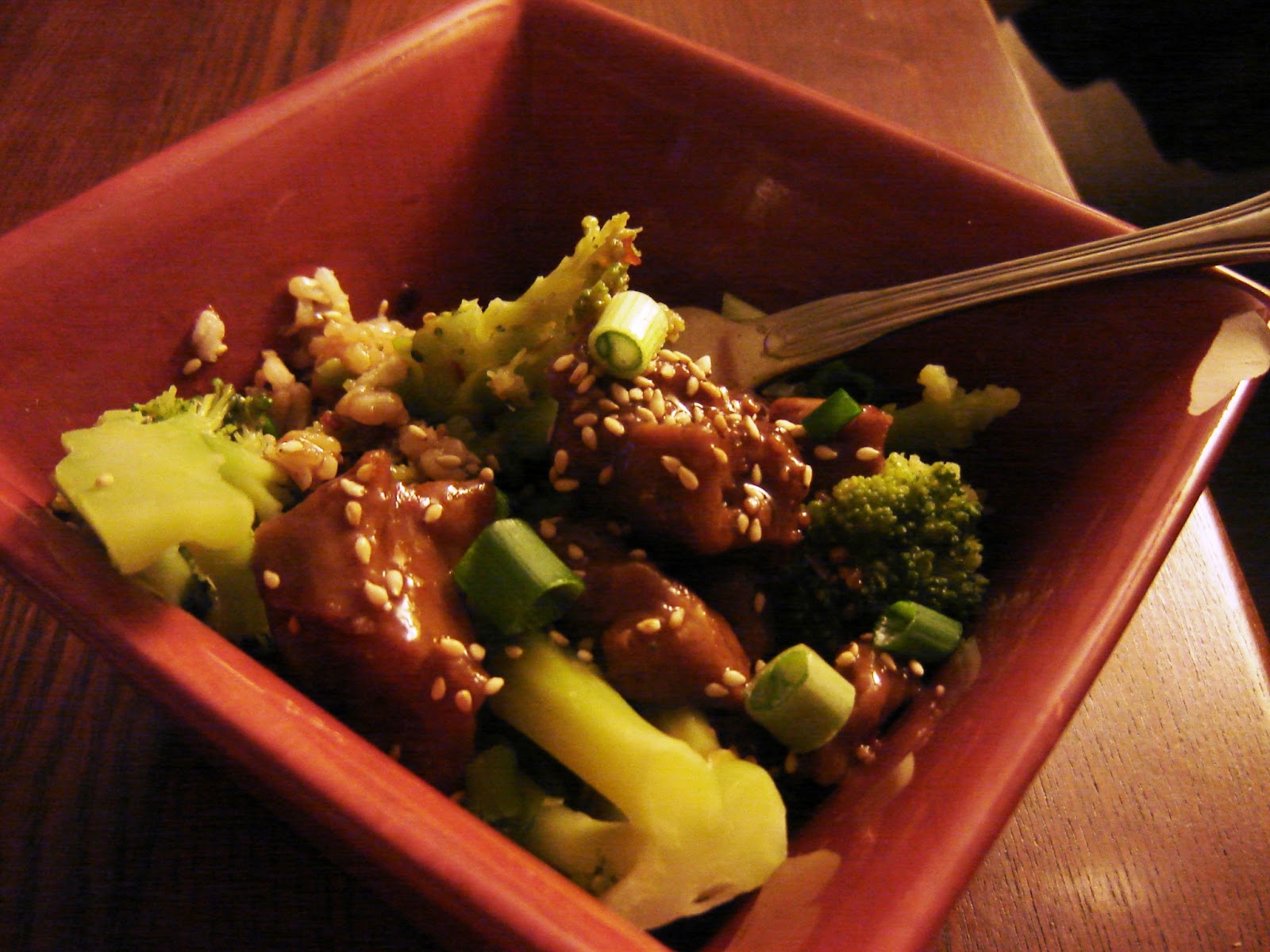
Seitan and Broccoli Bowl topped with Sesame Seeds and Scallions
Recipe:
Seitan and Broccoli Bowls
  • brown rice (enough for 6 servings)
  • 6 cups frozen (or fresh) broccoli florets 
  • a heaping 1/2 cup agave nectar
  • 6 tablespoons low-sodium soy sauce
  • 1/2 cup white wine (or vegetable broth)
  • 1/4 cup sesame oil
  • 2 tablespoons corn starch
  • 1 tablespoon minced garlic
  • 1.5 teaspoons crushed red pepper flakes
  • 24 ounces chopped seitan
  • 3 scallions, chopped
  • toasted sesame seeds, for garnish

First, begin preparing the rice according to the package instructions.  When about 15-20 minutes remain in the cooking time, set the broccoli to steam.  As the broccoli and rice are cooking, move on to prepare the sauce.

To make the sauce, whisk together the agave, soy sauce, wine, oil, corn starch, garlic, and red pepper flakes in a medium saucepan over medium-high heat.  When the sauce begins to boil, turn down the heat and simmer, stirring often, until the sauce thickens a bit.  Then, add the seitan to the sauce and continue cooking until heated through.

Finally, layer the rice, broccoli, and saucy seitan in a bowl, top with scallions and sesame seeds, and serve.

Yields 6 servings. 

Comments:

Taste:            
This flavorful, umami-filled dish is sweet, spicy, and satisfying.  The seitan, broccoli, and rice come together into a nice, substantive, healthy bite.  
Accessibility:            
While you can make seitan from scratch, we ventured to Whole Foods to buy prepared seitan (sold in the refrigerated section, often near the produce); it's not sold at other nearby grocery stores.  Don't let the agave nectar scare you--we had no trouble finding it at our regular grocery store, in the syrup/honey aisle.  Also, we found a small (single/double serving?) box of wine at the grocery store, meaning we didn't need to buy a whole bottle just for this recipe.
 Ease of Preparation:       
While there are several things going on at once in this recipe, they are all pretty low-maintenance and easy to do.  Using "instant" brown rice can speed things up.
Non-vegan friendliness:            
I'm intentionally calling this recipe Seitan and Broccoli Bowls, rather than "Beef" and Broccoli Bowls: seitan isn't the same as beef, so there's no need to force a comparison between them.  This healthy, tasty dish is satisfying on its own. 

Monday, August 6, 2012

Rajma Masala with Spinach

While I do still find time to cook in between applying for jobs, blogging has fallen by the wayside.  I made it a point to blog about the delicious red kidney bean dish we made last week, though.  We made Rajma Masala with Spinach--a creamy, filling Indian dinner. 

Rajma Masala served with rice and a samosa wrap.

Recipe:     
Rajma Masala with Spinach
  • 1/4 cup vegetable oil
  • 1 red onion, finely diced
  • 1 tablespoon ground ginger
  • 1 tablespoon garlic powder
  • 1 teaspoon turmeric
  • 1 heaping teaspoon cumin
  • 2 teaspoons coriander
  • 2 teaspoons chili powder
  • 1 teaspoon garam masala (or just add equal parts ground black pepper, cloves, nutmeg, and cinnamon)
  • 1 red chili pepper, seeded and minced
  • 1/2 cup unflavored tomato sauce
  • 3 tablespoons chopped cilantro
  • 1 - 15.5 ounce can dark red kidney beans, drained and rinsed
  • 1 - 15.5 ounce can light red kidney beans, drained and rinsed
  • 1 - 9 ounce bag fresh spinach (or more or less, to taste)
  • salt to taste
  • 1/4 cup vegan sour cream

First, heat oil in a large soup pot over medium-high heat.  Add onion and sauté until it begins to brown.  Then add the ginger, garlic, and 2 tablespoons water; cover and cook for two more minutes, stirring frequently.

Next, add the turmeric, cumin, coriander, chili powder, garam masala, chili pepper, tomato sauce, and cilantro. Cover and cook for about 3 minutes, stirring frequently.  Then add enough water to get a saucy consistency.

Finally, add the beans, spinach, and salt and cook for 10-15 minutes, or until spinach has wilted and flavors have combined. Remove from heat, mix in sour cream, and serve immediately with rice.

Serves 4-6


Comments:
Taste:       
The creaminess of this dish was definitely the highlight.  Rachel was pleasantly surprised that we were able to bring the smooth texture that she loves about Indian food to a vegan dish.  The dish wasn't too spicy--especially when combined with rice--but it still had a rich, complex flavor. 
Accessibility:    
At first glance, this dish might seem unmanageable.  Between the fairly unusual spices and the vegan sour cream, this recipe loses some of its accessibility.  However, we were able to find all of these spices and the vegan sour cream (Tofutti brand) at our usual grocery store.  You might be surprised what you can find quite easily these days.
 Ease of Preparation:        
This is a pretty straightforward recipe.  The Rajma Masala doesn't take too long to make, but rice can take a while.  Just be sure to start the rice before beginning this recipe.
Non-vegan friendliness:       
As I mentioned, we all loved the taste and texture of this dish.  Even though it was filling, we all wanted more.  I wrote that it serves 4-6 because it barely got the three of us through 2 dinners!

Sunday, June 10, 2012

Sesame Seitan

Nothing says "It's the weekend" like Chinese take-out, right?  Almost.  This weekend we made our own, vegan version of a take-out classic--sesame chicken--with pretty great results. 

Why order out when you can make Sesame Seitan right in your kitchen?
Recipe:     
Sesame Seitan
  • 2 - 8 ounce packages pre-made seitan (or you can make your own), drained and cut into bite-sized chunks
  • 1/2 cup + 1 cup flour (separated)
  • 2 cup ice water (you might not use it all, but have it on hand)
  • enough vegetable or peanut oil for frying
  • 1 yellow squash, chopped matchstick size
  • 1 onion, diced
  • 1/4 cup fresh, minced ginger
  • 2 carrots, shredded
  • 1.5 cups frozen broccoli
  • 1 cup frozen snap peas
  • 1/2 cup low-sodium soy sauce
  • 1/4 cup honey or another liquid sweetener
  • 2 teaspoons sesame oil
  • sesame seeds, toasted (to garnish) 
 
First, combine the seitan and 1/2 cup flour in a plastic bag and shake until the seitan is coated.  Set aside.

Next, prepare the batter.  Put 1 cup flour in a small bowl and slowly whisk in the ice water, using just enough water to create a smooth, somewhat sticky batter.

Now you're ready to batter and fry the seitan.  First, right next to the stove, set out a plate covered with paper towels (this is where you will place the seitan once it has cooked).  Pour oil 1/2" deep into a large skillet and heat on high until the oil is hot.  Then dip some floured seitan into the batter and immediately, with care (hot oil will burn you if it splatters!), place the battered seitan into the oil to fry.  Do this with as much seitan as can comfortably fit in the skillet at once.  You'll need to turn over the seitan halfway through cooking, using tongs.  Once the seitan looks crispy, remove it from the skillet using tongs and place it on the paper towel plate to absorb excess oil while you repeat these steps with the remainder of the seitan.  Allow the cooked seitan to rest on the plate and set aside.

Then cook the vegetables.  Take about 1.5 tablespoons oil from the seitan skillet and pour it into another large skillet or saucepan.  Heat the oil on medium-high and add all of the vegetables.  Cook, stirring occasionally, until they begin to brown.  Meanwhile, in a small bowl, mix together the soy sauce, honey, and sesame oil using a fork.  Add the sauce to the vegetables, stir, and then add the seitan and stir.  Cook until everything is heated through. 
 
Serve with brown rice and garnish with sesame seeds.  Yields 6 - 8 servings. 

Comments:
Taste:         
The breaded seitan is a little bit chewy and a little bit crispy, overall tasting shockingly similar to a dish you might find in a Chinese restaurant.  Beyond the sweet and savory sauce and the crunch that the vegetables add to the dish, my favorite part is the seitan's substantive mouthfeel.  You can really take a bite out of this dish, and each bite taken is incredibly satisfying.   
Accessibility: 
Unfortunately, a few of these ingredients are hard to find.  We buy seitan in large quantities at Whole Foods and store it in the freezer since we can't find it at our local grocery store.  Sesame oil is expensive, but you can buy it in little bottles (and there are numerous other recipes on this blog that call for it!).   
 Ease of Preparation:       
This was a fairly complicated dish to make, and we made quite a mess in the kitchen in the process.  Batter-splatter was everywhere.  But, I've tried to spell out the procedure as clearly as possible in the directions, above, so that everyone else can benefit from our first try.  
Non-vegan friendliness:      
I look forward to making this for non-vegan friends and family! 

Friday, May 25, 2012

Koshari

I first had koshari--a popular Egyptian street food--while visiting my brother when he was studying abroad in Cairo.  This traditionally-vegetarian dish combines a bunch of staple foods into one, resulting in a satisfying, though starchy, meal. 


Koshari: So many components, so few vegetables.

Recipe:    
Koshari
  • 1 - 14.5 ounce can chickpeas, drained and rinsed
  • 1/4 cup red wine vinegar
  • 1 teaspoon coriander
  • 1 teaspoon cayenne pepper
  • 1/2 teaspoon cumin
  • 1.5 cups white rice (plus water to cover)
  • 1.5 cups lentils (plus water to cook)
  • 1 pinch salt, or to taste
  • 1 pinch pepper, or to taste 
  • 8 ounces ditalini pasta (plus water to cook)
  • 1 tablespoon olive oil
  • 3 cloves garlic, minced
  • 1 onion, finely diced
  • 1 - 14 ounce can crushed tomatoes
  • 1 tablespoon vegan butter
  • 3 cups low-sodium vegetable broth
  • 1 small package or can French fried onions
 
First, marinate the chickpeas.  Combine the chickpeas, vinegar, and spices in a container with a tight-fitting lid.  Store the container in the refrigerator while preparing the rest of the dish, shaking occasionally to stir up the chickpeas.  
 
Next, in a small bowl, combine the rice with enough cold water to cover and allow to soak.  After 20 minutes, carefully drain the rice.   
 
Meanwhile, add the lentils to a medium saucepan and add enough water to more than cover the lentils.  Season with salt and pepper.  Bring the lentils to a boil and cook until tender (about 30 minutes, depending on the type of lentils you use).  If all of the water is absorbed before they are finished cooking, add a bit more water. 

As the lentils cook, prepare the pasta according to package instructions.  When the pasta is done cooking, drain and set aside. 
As all of these ingredients cook, prepare the tomato sauce.  Heat the olive oil and garlic in a medium saucepan over medium-high heat. When the oil becomes hot, stir in the onion and sautè for about 5 minutes.  Add the crushed tomatoes and salt and pepper to taste.  Reduce the heat to low and allow the sauce to simmer until the rest of the dish is ready. 

Once the rice has soaked for 20 minutes, you can begin to cook the rice.  Melt the vegan butter in a medium saucepan over high heat.  Add the rice to the pot and fry, stirring constantly, for about 4 minutes.  (Don't be too concerned if the rice starts to stick--the vegetable broth will deglaze the pan).  Add the vegetable broth while stirring, and bring to a boil.  Reduce the heat to low, cover the pot, and cook until the liquid has been absorbed (about 18 minutes).

Finally, when all of these components are ready, mix the rice and lentils together.  To serve, spread the pasta over the rice and lentil mixture and top with chickpeas, tomato sauce, and the French-fried onions.
 
Yields 8 servings.

Comments:
Taste:          
This is a really tasty dish with a rich yet earthy flavor.  Ours came out a bit mushy (I think we overcooked the rice by a few minutes), but the chickpeas and French-friend onions add some nice textural variation.  Overall, it was a pretty heavy dish.  
Accessibility: 
This dish makes use of numerous easy to find staple foods.  It would be a great dish to make in the winter when high-quality fresh ingredients are scarce.
 Ease of Preparation:       
There are many pieces to the koshari puzzle, as you can see.  However, most of the ingredients can cook at the same time; or, you could even make the lentils, rice, and pasta a day in advance.  Once all of the components are cooked, the assembly is quite easy. 
Non-vegan friendliness:      
This dish is extremely substantive.  I wouldn't serve this as a one-pot meal, however, as it's quite blatantly missing vegetables of any kind. 

Wednesday, May 23, 2012

Cool Caribbean Curry with Plantains

Last night was a night of firsts for the ladies and gentleman of this apartment: we used both plantains and black-eyed peas for the first time.  I'm just as surprised as you are that we hadn't cooked up some black-eyed peas before now (seriously, though, I think my soft spot for black-eyed peas can only be attributed to the fact that they remind me of black-eyed Susans).  Our adventure was successful, as you can see:

Warning: This is Not Your Average Curry.
Recipe:   
Cool Caribbean Curry with Plantains
  • 3 very ripe plantains, peeled, split lengthwise and cut into 1 inch chunks
  • 2 tablespoons olive oil
  • 1/2 cup finely chopped shallots
  • 1 large red pepper, diced finely
  • 1 jalapeno pepper, seeded and minced
  • 4.5 cloves garlic, minced
  • 1 tablespoon minced ginger
  • 3 bay leaves
  • 1 tablespoon curry powder
  • 1/8 teaspoon cinnamon
  • 1/2 teaspoon ground thyme
  • 3/4 teaspoon salt
  • 1 1/8 cups lite coconut milk
  • 1 1/8 cups water
  • 2 - 15 ounce cans black-eyed peas, drained and rinsed
  • 1.5 teaspoons honey
  • 1.5 teaspoons lime juice
  • 3 cups brown rice, prepared according to package instructions
 
First, steam the plantains.  Insert a steamer basket or metal sieve into a medium-sized saucepan and add an inch or two of water (the water should be below the bottom of the steamer basket/seive).  Bring the water to a boil and place the plantains in the steamer basket/seive.  Cover the pot and steam for about 10 minutes or until the plantains look bright yellow and plump.  Drain the water, re-cover the plantains to keep them warm, and set aside. 

Meanwhile, prepare the curry.  Heat the oil in a large skillet over medium-high heat.  Add the shallot and peppers and sauté for about five minutes, stirring occasionally.  Add the garlic, ginger, and bay leaves and continue cooking for another two minutes.  Next, add a splash of water and stir in the curry powder, cinnamon, and thyme.  Mix for 30 seconds before adding the salt, coconut milk, water, and black-eyed peas.  Cover and cook for 5 more minutes.  Finally, add the honey and lime juice and any extra salt or seasoning, to taste.  Remove from heat and let stand for 10 minutes before serving.  
 
To serve, spoon the curry over a bed of brown rice and top with plantains.  Yields 6 servings.

Comments:
Taste:         
This dish is both visually appealing and pleasing to the palate.  The colors are as bright as the flavors.  The creamy coconut milk tempers the curry powder and jalapeno, so the dish is really more mild than spicy.  And I really enjoy the meatiness of the plantains--they're really nice to bite into, which is a sensation that is often missing in many vegan recipes. 
Accessibility: 
Despite the fact that Uganda was the top producer of plantains in 2009 (according to Wikipedia) and I live in the U.S., we had no trouble finding them at the grocery store--along with all of the other ingredients.  Isn't it funny how that works?
 Ease of Preparation:     
This dish depends pretty heavily on having the kitchen tools needed to steam the plantains (or you can always do this).  That said, the actual cooking process is pretty simple.    
Non-vegan friendliness:      
We all enjoyed this dish.  Simon says that the hearty plantains are a welcome addition to the meal. 

Thursday, May 17, 2012

Coconut Curried Fried Rice with Tofu

So much friendship; so much food!  Rachel and I had a friend over for dinner on Monday night.  We made a recipe which was passed along to me by another friend who has been living in China for the past year.  We enhanced the original recipe with a few little changes, and the results were quite favorable.

This dish pairs quite well with white wine, by the way.

Recipe:   
Coconut Curried Fried Rice with Tofu

Coconut Rice
  • 1/2 cup water
  • 2 cups lite coconut milk (or enough water + coconut milk to equal 2.5 cups liquid)
  • 1 teaspoon turmeric
  • 1/2 teaspoon salt
  • 2 cinnamon sticks
  • 3 cups brown minute-rice
Prepare the rice first (or in advance).  Combine all ingredients except rice in a saucepan and bring to a boil.  Stir in the rice and return to a boil.  Then reduce the heat to low, cover the pot, and simmer for 5 minutes.  Then remove from heat, stir, and let the rice stand 5 minutes or until all of the liquid has been absorbed.  (Or, if you are using regular rice, prepare according to package instructions.)  Remove the cinnamon stick and set aside (or refrigerate until ready to use).

Curried Fried Rice with Tofu
  • 1 head bok choy, chopped, keeping the white and green bits separate
  • 2 packages extra-firm tofu, pressed and cut into small cubes
  • 1/4 cup olive or peanut oil
  • 1 garlic cloves, minced
  • 1 - inch chunk of ginger, peeled and minced
  • 1 tablespoon curry powder
  • 2 carrots, diced
  • 1.5 cups frozen peas
  • 1 - 15 ounce can diced tomatoes
  • 2 tablespoons soy sauce
  • 2 teaspoons lime juice
First, prepare the bok choy.  I chose to steam the bok choy to give it a head start on cooking before adding it to the fried rice.  If you don't have a vegetable steamer, put about 3/4" water in the bottom of a saucepan and bring it to a boil.  Add the white bits of bok choy, cover, and steam for 2 minutes before adding the green leaves and cooking, covered, for another 2 minutes.  Once the bok choy is pretty tender, drain and set aside.

Next, prepare the tofu.  Heat the oil in a large skillet over medium-high heat.  When the oil is hot, carefully add the tofu and allow to rest for a few minutes before turning it.  Continue cooking and turning until the tofu has browned on most sides.  Set aside.  

At this point, it's time to begin the fried rice.  Heat the garlic, ginger, and carrot over medium-high heat using the skillet in which you cooked the tofu (there should be a little oil left in the bottom--if there isn't, add a little more). Cook for about 5 minutes, stirring occasionally.  Then add the curry powder and cook for another minute, stirring constantly.  Add the rice, peas, tofu, tomatoes, and bok choy and cook until heated through.  Finally, stir in the soy sauce and lime juice. 

Serves 6-8 people. 

Comments:
Taste:         
This is a beautifully colorful dish with a creamy texture and mild flavor.  I would have preferred if it were a bit spicier (I might add 1 minced jalapeno the next time I make this); Simon agrees that it was a bit bland.  Even though the flavor isn't too powerful, the dish definitely packs in a bunch of tasty vegetables and protein.  We all agreed that the carrots add a nice crunch to the dish, and we could have added raisins, too.
Accessibility: 
This is a very flexible dish.  Any of the vegetables could be swapped in our out depending on preferences, availability, and price.  For the record, bok choy was available at our regular grocery store, so it's probably available at yours too. 
 Ease of Preparation:      
It took a while to prepare this dish.  To cut down on prep time, you could prepare the rice and bok choy a day in advance (Maybe you don't even need to pre-cook the bok choy, but I didn't want to risk crunchiness, given our guest!).  Or, you might try using leftover rice.
Non-vegan friendliness:     
Simon, our very own carrot deflator, didn't think this dish was substantial enough to stand on its own.  That said, the three women agreed on Monday evening that it was a good meal.  With or without the tofu, this could also be a nice side dish. 

Tuesday, April 17, 2012

Gumbo Z'Herbes

Cajun Week Part 2: Gumbo Z'Herbes!  As I mentioned before, this version of gumbo is surprisingly meat-free.  The dish below looks a lot like the gumbo I had last week in New Orleans, though due to a salt-related mishap, it was much saltier. 

Gumbo Z'Herbes, soon to be topped with rice.
I'll post the recipe below with a more palatable amount of salt.  Give it a try!

Recipe:  
Gumbo Z'Herbes
  • 2 quarts water
  • 1/2 cup olive oil
  • 1/2 cup flour
  • 1 cup diced onion
  • 1/2 cup diced green bell pepper
  • 1/2 cup diced celery
  • 1/2 cup minced shallots
  • 2 tablespoons minced garlic
  • 3 bay leaves
  • 3/4 teaspoon thyme
  • 1.5 teaspoons black pepper
  • 1/2 teaspoon cayenne pepper
  • 1 tablespoon salt
  • 1/2 pound mushrooms, chopped
  • 10 ounces frozen collard greens (or a bunch of fresh greens)
  • 1 small head of cabbage, cut into 1 inch pieces
  • 5 ounces frozen turnip greens (or a small bunch of fresh greens)
  • 6 scallions, diced
  • 1/8 cup chopped parsley 
  • 1 tablespoon soy sauce
  • 2 - 15 ounce cans red kidney beans
  • Brown rice, prepared according to package instructions.

First, bring the water to a boil in a large soup pot.  (While waiting for the water to boil, continue with the recipe in the next paragraph.  Once the water boils, continue with the third paragraph.)     

Meanwhile, prepare the roux.  Heat the olive oil in a separate large, heavy-bottomed pot over medium-high heat.  Then add the flour and stir constantly until a peanut butter colored roux is attained.  Immediately add the onion, bell pepper, and celery and sauté until the vegetables become tender.  Add the shallots, garlic, herbs, spices, and salt and continue to cook for five minutes, stirring occasionally.  Next, add the mushrooms to the roux mixture and cook for two more minutes.

Once the water in the soup pot is boiling, add the collards and cabbage and boil until tender.  Then stir in the turnip greens and scallions and bring the soup mixture back to a boil.   

Stir the roux mixture into the soup mixture.  Once combined, add the parsley, soy sauce and kidney beans and simmer for at least 10 minutes.  Top with brown rice and serve hot. 

Yields 8 servings.

Comments:
Taste:       
Mistaken saltiness aside, this dish had a great, deep flavor.  That's probably partly due to the addition of mushrooms (something I don't cook with very much, to Rachel's chagrin) and the roux base.  I also love that the gumbo is packed with a variety of dark leafy greens, cabbage, and other vegetables.   
Accessibility:      
There are a lot of ingredients in this version of Gumbo Z'Herbes, but they're all easy to find at the grocery store.  If you can't find some of the dark leafy greens (turnip greens, collard greens), I'm sure you could swap in some other dark leafy greens (mustard greens, etc.) in their place.      
 Ease of Preparation:    
Apparently Cajun cooking isn't the easiest.  Like the Seitan Jumbalaya I made earlier in the week, this dish has a number of steps and takes a while to make. Plus, it requires a pretty high level of attention during some more complex steps, such as roux-making.  But, don't be discouraged: I'm pretty sure this was my first time making a real roux and it was straightforward enough. 
Non-vegan friendliness:    
While we did have this as the main dish at dinner, I could see some non-vegans being unsatisfied with such a light main course.  This dish is less filling than some of the soups I've made previously, so it might work better as an appetizer.