Showing posts with label squash. Show all posts

Saturday, October 27, 2012

Chickpea-Squash Stew served over Quinoa

Did you know that 2013 has been declared Year of the QuinoaAs wonderful as quinoa is, it's a bit underrepresented on this blog.  Here's a recipe to change that. 

So colorful and healthy!

Recipe:     
Chickpea-Squash Stew served over Quinoa

  • 4 cups cubed (1/2 inch) and peeled butternut squash 
  • 1 1/3 cup quinoa
  • 2 2/3 cup water
  • Pinch of salt
  • 4 teaspoons olive oil
  • 2 onions, diced
  • 1 teaspoon salt
  • 1/4 cup minced fresh ginger
  • 1 jalapeno, seeded and minced
  • 4 cloves garlic, minced
  • 1 cup lite coconut milk
  • 2 - 14 ounce cans petite diced tomatoes
  • 2 - 14 ounce cans chickpeas, drained and rinsed
  • 4 green onions, chopped

First, boil the squash in a medium/large saucepan until just tender, about 15 minutes.  Drain, rinse, and set aside.  
 
Meanwhile, cook the quinoa.  Combine the quinoa and water in a medium saucepan and bring to a boil.  Reduce the heat to low, cover, and cook for about 15 minutes or until the water is absorbed.  Then remove the quinoa from the heat, fluff with a fork, and cover to keep warm.
 
While the squash and quinoa are cooking, begin to cook the stew.  Heat the olive oil over medium-high heat in a large skillet. Add the onions and salt and cook until the onions begin to brown, about seven or eight minutes. Add the ginger and jalapeno and cook for two more minutes, stirring constantly. Add the garlic and cook for another minute.  Then add the coconut milk, tomatoes, chickpeas, and cooked squash and bring the mixture to a boil.  Reduce the heat and simmer until the squash is tender, stirring frequently, about 15 minutes.

Ladle the stew over the quinoa and garnish with green onions before serving hot.  Yields 8 servings.

Comments:
Taste:            
We all enjoyed this colorful, flavorful dish.  The nuttiness of the quinoa and the heartiness of the squash and chickpeas make this a solid, everyday dish.  Plus, the coconut milk and jalapeno balance each other nicely. 
Accessibility:          
We didn't have trouble finding any of these ingredients at our standard grocery store. 
 Ease of Preparation:          
As long as you're sure to multitask by cooking the quinoa and squash at once, this dish doesn't take too long.  I find that it's easiest to dice the hard squash using a heavy chopping knife. 
Non-vegan friendliness:         
Simon noted that there's nothing missing from this dish; at the same time, he considers it more of a hearty side dish than a main dish.  I really like the aesthetics of this dish, and I'd be confident serving it to non-vegans, especially during fall!       

Tuesday, September 25, 2012

Maafe (West African Peanut Stew)

Virginia is famous for its peanuts, but I recently learned that the history of Virginia peanut soup goes far beyond colonial Williamsburg.  Maafe, a traditional West African dish first made by the Mandinka and Bambara people of Mali, was brought to the United States through the slave trade and is the direct ancestor of Virginia peanut soup, according to African American foodways specialist Michael TwittyMaafe can be served with rice, couscous, or sweet potatoes, but when we made it the other night, we ate it as a stand-alone stew.  

I promise it tastes better than it looks.
Recipe:     
Maafe
  • 2 tablespoons olive oil
  • 6 cloves garlic, minced
  • 3 onions, diced
  • 1 - 28 ounce can crushed tomatoes
  • 1 - 6 ounce can tomato paste
  • 1.5 cups low sodium vegetable broth
  • 1/3 cup smooth peanut butter
  • 1/4 teaspoon cayenne pepper
  • 1 teaspoon salt
  • 1 teaspoon pepper
  • 2 bay leaves
  • 1 acorn squash, peeled and cubed
  • 1 - 10 or 14 ounce bag of cole slaw cabbage 

First, heat the oil and garlic in a large soup pot over medium-high heat.  Once the oil is hot, add the onions and cook for five minutes, stirring occasionally.

Then add all remaining ingredients except the cole slaw cabbage.  Stir together and bring to a boil.  Then add the cabbage and cook, stirring frequently, for about 30 minutes, or until the squash is tender and can be easily pierced with a fork.

Serve hot over rice or on its own.  Yields 6 servings.

Comments:
Taste:          
Rachel and I are maafe's new biggest fans.  The sauce is incredibly rich and creamy, and the peanut butter taste is subtle but pleasant.  My favorite part was that the acorn squash almost melts in your mouth.  Rachel compared the flavor of the sauce to chicken makhani.  Simon wasn't as keen on the dish because it lacked something to bite into, but I think serving it over rice or with some bread to dip in would add a bit more heft.
Accessibility:        
None of these ingredients is difficult to find.  You can substitute the bag of cole slaw for half of a head of cabbage, if you prefer. 
 Ease of Preparation:         
The recipe is pretty simple, but peeling the acorn squash was the opposite of simple.  It took forever to peel because of the ridges!  (We also don't have a vegetable peeler, which surely didn't help.)  Next time, I might try out these tips for peeling acorn squash: http://lazyhomesteader.com/2011/10/11/how-to-peel-an-acorn-squash/. 
Non-vegan friendliness:         
This dish has a great flavor and smooth texture, though I think it would be best eaten along with rice, bread, or something else (rather than on its own). 

Wednesday, August 15, 2012

Summer Squash Bread

Although I haven't yet figured out how to cultivate a garden in my apartment, I was fortunate enough to receive two home-grown summer squashes from my parents' garden.  Thank you, mom and dad, for enabling me to make Summer Squash Bread! 

A sweet, fragrant loaf of squash bread.

Recipe:     
Summer Squash Bread
  • 3 cups all-purpose flour
  • 2 teaspoons cinnamon
  • 2 teaspoons baking soda
  • 1 teaspoon baking powder
  • 1/2 teaspoon nutmeg
  • 1/2 teaspoon salt
  • 2 cups grated summer squash
  • 2 cups sugar
  • 1/4 cup canola oil
  • 1/4 cup olive oil
  • 2 tablespoons honey or another liquid sweetener
  • 1 ripe banana, mashed
  • 1 carrot, grated
  • zest of 1 lime
  • 1.5 cups Ghirardelli chocolate chips (optional)

First, preheat the oven to 375 degrees Fahrenheit.  Place 12 muffin cups in a muffin tin and set aside.  Lightly grease a loaf pan and set aside. 

Next, mix together the flour, cinnamon, baking soda, baking powder, nutmeg, and salt in a large bowl.  Form a well in the center of the bowl and set aside.  In a separate medium bowl, mix together the remaining ingredients (except chocolate chips).  Pour the wet ingredients into the bowl of dry ingredients and stir until just combined.  Then fold in the chocolate chips.

Fill the muffin cups 3/4 full with batter; then pour the remaining batter into the loaf pan.  Bake both pans for 25-30 minutes, or until a toothpick inserted near the center of a muffin comes out clean.  Once the muffins have been removed, lower the oven temperature to 350 degrees Fahrenheit and bake the loaf for another 15-20 minutes, or until a toothpick inserted into the center comes out clean.  Once the muffins have cooled for a few minutes in the pan, remove them to cool completely on a wire rack. 


Yields 12 muffins and 1 loaf.

Comments:
Taste:        
I'm not sure there are many more delicious ways to eat squash.  This spiced bread is moist and dense, yet springy.  I'd say it's almost more of a cake than a bread.  The chocolate chips are optional--and the bread would be great without them--but for the chocoholic like me, they do add a little something special.  
Accessibility:     
This "bread" recipe makes use of a healthy number of fruits and vegetables (pun intended!), so it's probably best made in the summer. 
 Ease of Preparation:        
If you have a grater attachment on your food processor, this is a good time to use it.  Once the ingredients are ready to go, the method is quite simple.
Non-vegan friendliness:       
I brought the muffins in to work and they were a big hit!  My vegan/gluten-free coworker and I are slowly but surely exposing our office to the joys of vegan baking. 

Thursday, January 19, 2012

Spaghetti Squash Mexicana topped with Tropical Salsa

In keeping with this week's emerging theme, tonight's dinner was Spaghetti Squash Mexicana topped with Tropical Salsa.  (This is another great recipe from the ever-reliable cookbook Veganomicon.)  I've made this dish numerous times before and it never ceases to amaze me.  Spaghetti squash is awesome.  There's no better way to put it.  It starts out looking like a regular old squash, but once it's done it looks like spaghetti!  It's a miracle of nature.  Spaghetti squash is a versatile, lower-calorie, vegetable version of spaghetti.  What's not to like?     


The incredible edible spaghetti squash.
Recipe:
Spaghetti Squash Mexicana topped with Tropical Salsa

  • 1 spaghetti squash (in the 3-pound range)
  • 1 cup tomato, chopped into 1/2-inch chunks
  • 1 mango, chopped into 1/2-inch chunks
  • 1 avocado, peeled, pitted, and chopped into 1/2-inch chunks
  • 1/4 cup chopped cilantro
  • 2 tablespoons lime juice
  • 1 tablespoon olive oil
  • 1 onion, diced
  • 2 jalapenos, seeded and chopped finely
  • 3 cloves garlic, minced
  • 2 teaspoons ground coriander
  • 1.5 teaspoons chile powder
  • 1/2 teaspoon cumin
  • 1/4 teaspoon cinnamon
  • 1/2 teaspoon salt
  • 1/2 cup red cooking wine
  • 1 cup frozen corn, partially thawed
  • 1 - 15 ounce can black beans, drained and rinsed
  • 1 tablespoon hot sauce
First, bake the squash.  Preheat the oven to 375 degrees.  Cut the squash in half widthwise and use a spoon to scoop out the seeds.  Fill a baking dish with an inch of water and place the squash cut side down in the dish.  Bake for about 45 minutes, or until the skin is easily pierced with a fork.  Then, take the squash out of the pan and let cool for about 10 minutes until you can handle the squash.  Shred and scoop out the flesh with a fork into a bowl, cover, and set aside.  While the squash is baking, prepare the tropical salsa and the bean mixture.

Salsa: stir together the tomato, mango, avocado, cilantro, and lime juice in a small bowl.  Cover and refrigerate until ready to use.

Bean mixture: Heat the olive oil, onion, and jalapeno in a large skillet over medium-high heat.  Sauté for 5 minutes.  Add the garlic, spices, salt, and wine, and boil for 2 minutes, stirring often.  Next, lower the heat to medium and add the corn, black beans, and hot sauce.  Cook for 5 more minutes or until heated through.  Finally, add the squash to the bean mixture and toss to mix.  (It's helpful to use tongs here to ensure that the squash breaks up and everything is well incorporated.)

Top with salsa and serve.  Serves 4-6 people. 

Comments:

Taste:    
This is a good dish.  Simon remarked that "it might not be phenomenal, but [he's] happy to eat it."  I particularly like this dish--it's interesting, unconventional, surprising, and tasty.  It also has a great combination of textures.    
Accessibility:   
Unfortunately, this isn't a particularly accessible dish.  Many of the ingredients might be difficult to find--such as ripe fruits and spaghetti squash--while ingredients like wine could be expensive.  Nonetheless, we found all of these ingredients at Giant.    
Ease of Preparation:   
The squash takes a long time to bake, but I bet you could do so in advance to save time.  I might try that next time.  Once it's ready, though, the rest of the recipe is quite simple. 
Non-vegan friendliness:  
Simon pointed out that this dish doesn't lack meat or cheese (or any other animal product).  It's a dish best served vegan.  However, it's also a dish based around a potentially intimidating food for vegans and non-vegans alike: spaghetti squash.  I first tasted this kind of squash a couple years ago, and I must admit I wasn't excited about it.  I've been fully converted, though, and I recommend that everyone give it a try.

Tuesday, November 29, 2011

Butternut Squash Saag

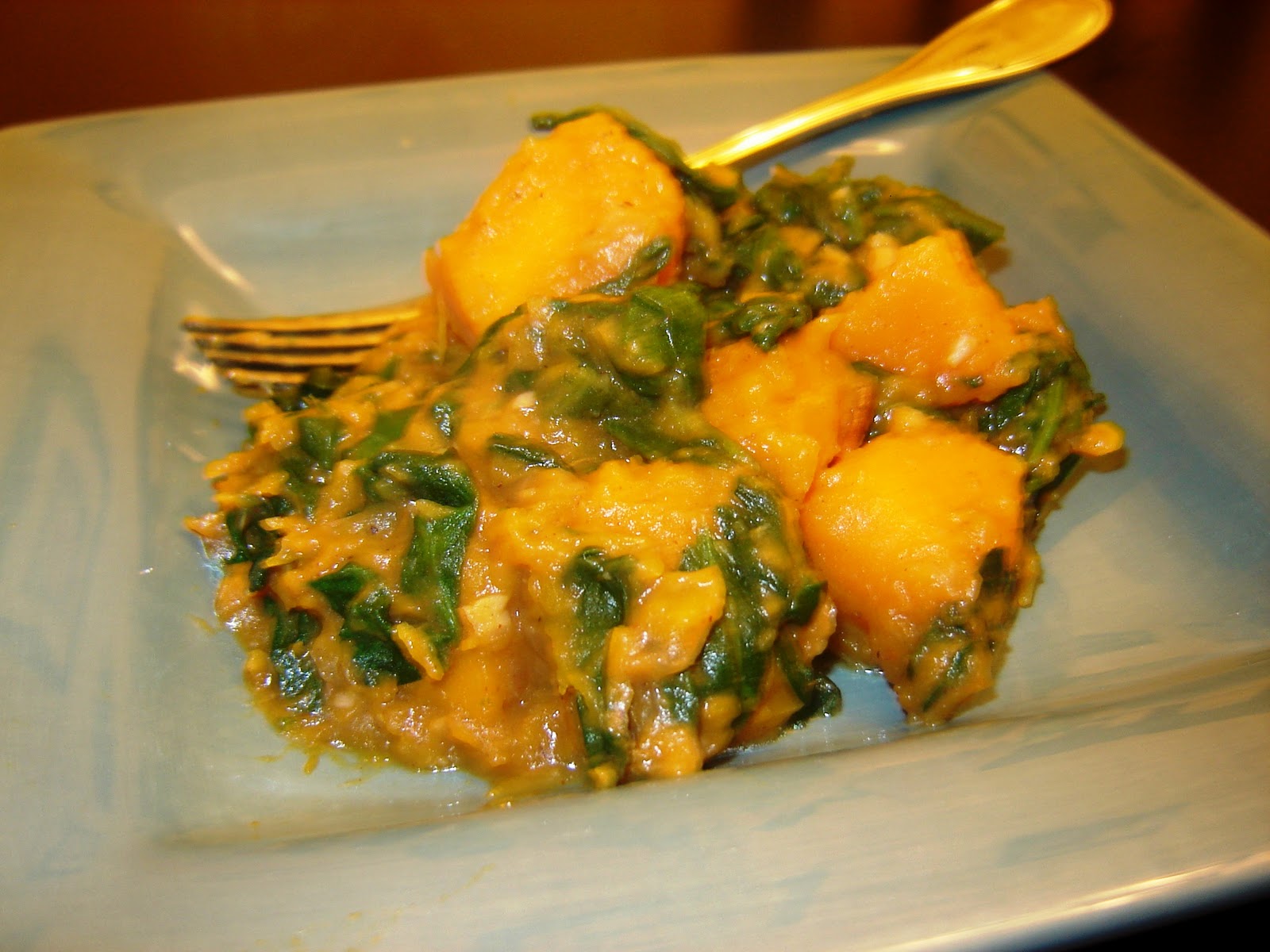
Rachel and I made Butternut Squash Saag tonight--an Indian inspired dish.  Again, it's great to have something spiced and warm to eat on a cold, rainy day.  You could also use pumpkin or some other squash in this recipe, depending on your preferences.   

I've decided to start incorporating pictures into my blog, so here's the final product!


I'll have to keep working on my food photography since food is notoriously difficult to capture on camera; but, I think this picture captures the beautiful colors in the dish quite nicely! 

Recipe:
Butternut Squash Saag

  • 1 butternut squash
  • 3 tablespoons vegetable oil or peanut oil
  • 1 large onion, diced finely
  • 4 cloves garlic, minced
  • 1.5 teaspoons garam masala (if you don't have this, mix together cumin, coriander, cardamom, pepper, cloves, and nutmeg--this will come close!)
  • 1/4 teaspoon ground cinnamon
  • 1/2 teaspoon salt
  • 1/8 teaspoon cayenne pepper
  • 1 cup water
  • 1-inch cube fresh ginger, peeled and minced finely
  • 10 ounces fresh spinach (approximately 2 bunches), washed and chopped coarsely
  • juice of 1/2 lime

First, prepare the squash.  Preheat the oven to 350 degrees Fahrenheit.  Using a strong knife and a careful hand, cut the squash in half lengthwise.  Remove the seeds and seed-goo with a spoon.  Place the squash cut side down in a baking dish and fill the dish with about an inch of water.  Bake for 45 minutes, until you can easily insert a fork into the flesh.  Once the squash is baked, let it cool completely before peeling away the skin and chopping it into 1-inch chunks.
Next, move on the the rest of the dish.  Heat the oil in a large saucepan over medium-high heat.  Add the onions and sauté for about 5 minutes.  Add the garlic and sauté for a couple more minutes until everything is lightly brown.  Add the squash and continue cooking for a few minutes until the mixture is heated through.  Add the spices, salt, and ginger.  Stir the mixture and add the water.  Continue cooking for about 5 minutes, stirring frequently.  You can mush up the squash a bit if you'd like smaller pieces, but do leave some pieces chunky.  Add the spinach in batches, stirring well between additions.  Cook for about 10 more minutes, stirring frequently.  Add the lime juice, and enjoy! 

Comments:
I had never had Butternut Squash Saag before, but it was worth the try!  The dish wasn't spicy (though you could add more cayenne to change this); instead, it was pleasantly spiced and gave off a nice aroma.  Plus, as I mentioned before, the colors were great.  This dish appeals to many senses!  We didn't serve the saag over rice, though you could do so to add more bulk.

Rachel was also pleasantly surprised by the saag.  She thought the flavor combination was unexpected and unlike other dishes she has had in the past.  She (and I) thought we could've cooked the squash a bit longer, but that is easily remedied.

Time-saving note: I cooked the squash one day in advance to avoid a really extended prep time tonight, and I think that was a great move.  If you decide to cook the squash in advance, just make sure you let it cool, cover it in plastic wrap or put it in a sealed container, and refrigerate it.